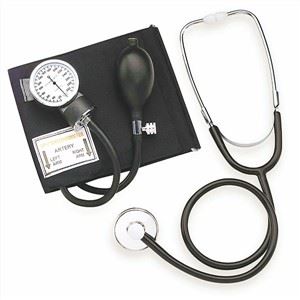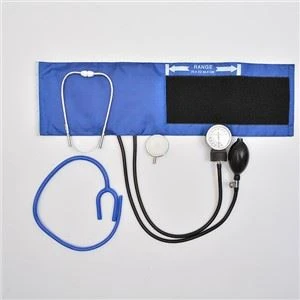

Manual mechanical blood pressure monitors are one of the most commonly used products in both daily life and medical treatment, which are used to detect patients' blood pressure values and help doctors pay better attention to their health.The product consists of a sphygmomanometer gauge that displays blood pressure readings, usually in millimeters of mercury (mmHg);adult nylon cuff used to wrap around the upper arm; latex bulb and bladder used to inflate into the cuff to pressurize it.

Product Parameters
| Brand Name | EXANOVO or OEM |
| Model | MC-20B |
| Pressure range | 0 to 300mmHg |
| Accuracy | ±3mmHg |
| Sub-division | 2mmHg |
| Gauge Material | Zinc/Aluminum alloy |
| Cuff | Nylon |
| Bulb | Latex |
| Bladder | Latex |
| D ring of cuff | Optional |
| OEM | Acceptable |
| Bag | Durable leather bag |
| Certificate | CE/ISO |
| Packaging | 50 sets/box |
| Advantage | Light and compact, easy to carry,suitable for health care |


Instruction of Use
1. Locate the pressure sleeve
Repeat this process several times to familiarize yourself with the equipment. Relax 15 minutes before taking your blood pressure. This reduces false readings due to physical activity. If you are right handed, push the cuff over your left arm and turn your left hand up. Whether you're sitting or lying down, make sure your arms are at the same level as your heart. Turn the cuff so that the stethoscope membrane (sound head) is located on the inside of the arm, directly against the elbow. Therefore, it is located right on the major artery at the bend of the elbow. (This artery can also be detected by feeling the pulse of the artery.) Take one end of the cuff, tie it tight, and then wrap it around your arm. Then attach the cuff with Velcro.
2. Roll up your sleeves
Check the arterial pulse with your fingertips, making sure the stethoscope is just above the arterial pulse. Insert the stethoscope into the ear (insert the stethoscope into the ear so that the stethoscope fits comfortably into the ear). Open the air valve on the balloon (turn clockwise) and do not inflate the balloon. Press the balloon repeatedly with your right hand to close the cuff. When you can't hear a pulse, increase the pressure by another 30 millimeters.
3. Slowly let the air out of the sleeve
Slowly open the valve by turning counterclockwise to reduce the stroke pressure by about je2-4mmHg. (This usually means that the pressure on the meter drops by 1 to 2 points per second.)
This is important for proper reading. Remember, the pressure on the cuff cuts off circulation to the arm. Therefore, do not allow the cuff to expand longer than necessary.
4. Systolic pressure
After the valve is opened, listen carefully for the pulse. When you hear a faint pulse rhythm, note the reading on the meter. This is the systolic pressure. This may be an unusual piece of equipment for you, so listen carefully and get used to it. In addition, you should pay attention to the indicator on the meter, because it will "jump" once the system pressure is reached
Usage Precautions
Make sure the cuff is not leaking and the blood pressure monitor is in good condition before taking any readings.
To prevent influencing the measurement results, maintain a steady breathing pattern during the procedure.
To get the arm's blood flowing normally again after each measurement, completely deflate the cuff and untie it.
To guarantee data accuracy when taking continuous measurements, a minimum of one minute should elapse between each measurement.
Hot Tags: manual mechanical sphygmomanometer, China, suppliers, manufacturers, factory, wholesale, cheap, made in China, Handheld Manual Sphygmomanometer, Professional Manual Sphygmomanometer, Handheld Aneroid Sphygmomanometer, Sphygmomanometer with Stethoscope, Accurate Manual Sphygmomanometer, Manual Aneroid Sphygmomanometer