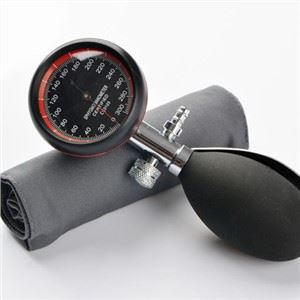


The EXANOVO MC-20C Clinical Manual Aneroid Sphygmomanometer is a high-performance medical instrument meticulously engineered for precise, reliable blood pressure monitoring in professional clinical environments. Combining robust stability, enhanced portability and intuitive operation, it stands out as an essential tool for hospitals, clinics, community health centers and mobile medical teams, delivering accurate, consistent readings to support clinical diagnosis and patient care.
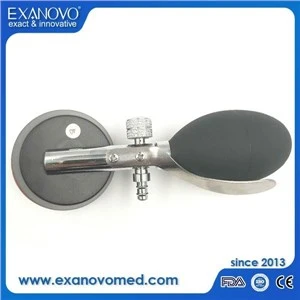
Crafted with a premium aluminum alloy gauge, this sphygmomanometer boasts a pressure measurement range of 0 to 300mmHg, paired with an impressive accuracy of ±3mmHg and a clear 2mmHg scale division-ensuring that every reading is precise and easy to interpret. The soft, skin-friendly nylon cuff ensures optimal comfort for patients during extended use, while the high-durability PVC bulb and bladder are designed to withstand the frequent, repeated use typical of clinical settings, enabling smooth, consistent inflation and deflation.
Designed with clinical practicality in mind, its lightweight and compact structure facilitates easy portability, making it ideal for on-site consultations and mobile healthcare services. Each unit is equipped with a durable leather storage bag, which not only protects the device from damage but also simplifies storage and transportation, perfectly adapting to the dynamic needs of professional clinical work.
Product Parameters
| Brand Name | EXANOVO or OEM |
| Model | MC-20C |
| Pressure range | 0 to 300mmHg |
| Accuracy | ±3mmHg |
| Sub-division | 2mmHg |
| Gauge Material | Aluminum alloy |
| Cuff | Nylon |
| Bulb | PVC |
| Bladder | PVC |
| D ring of cuff | Optional |
| OEM | Acceptable |
| Bag | Durable leather bag |
| Certificate | CE/ISO |
| Packaging | 50 sets/box |
| Advantage | Light and compact, easy to carry,suitable for health care |
Product Advantages
1. Clinical-Grade Precision: Stable mechanical structure; after calibration, accuracy rivals that of a mercury sphygmomanometer, with no risk of electronic drift.
2. Safe and Mercury-Free: Replaces traditional mercury sphygmomanometers, eliminating mercury pollution; safe for both clinical and field environments.
3. Durable and Easy to Maintain: No electronic components; shockproof and drop-resistant; easy to clean; long lifespan.
4. Portable and Versatile: Small size and lightweight; not limited by power supply; suitable for hospitals, clinics, homes, and emergency situations.
5. Economical: Affordable price; no battery replacement costs for long-term use.
Instructions for Use (Operating Procedure)
To ensure clinical accuracy, it is recommended to follow the standardized measurement procedure below:
1. Preparation: The patient should sit quietly for at least 5 minutes with back support, feet flat on the floor, and avoid talking.
2. Positioning: Place the lower edge of the cuff 2-3 cm above the elbow crease, aligning the tubing with the brachial artery. The arm should be at heart level.
3. Palpation and Estimate (Key Step): First, palpate the radial artery pulse, inflate until the pulse disappears, then increase the pressure by 30 mmHg. This is to avoid underestimating systolic blood pressure due to the "auscultation gap."
4. Auscultation: Place the chest piece of the stethoscope at the point of strongest brachial artery pulse (Note: Do not completely tuck the chest piece under the cuff to avoid interfering with the sound).
5. Deflating and Reading: Deflat the cuff slowly at a rate of 2-3 mmHg/second. The first clear tap (Korotkoff sound stage I) is the systolic blood pressure; the point where the sound disappears (Korotkoff sound stage V) is the diastolic blood pressure.
Precautions for Use
1. Regular Calibration: Professional calibration is recommended every 6-12 months to ensure accurate readings.
2. Correct Cuff Size: The cuff bladder width should cover 80% of the upper arm circumference; a cuff that is too narrow will result in an inflated reading.
3. Standard Operation: Measure the blood pressure after the patient has rested in a seated position for 5 minutes. The cuff should be at the same height as the heart.
4. Auscultation Required: Measure using a stethoscope. Use Korotkoff sounds to determine systolic and diastolic blood pressure.
5. Avoid Vibration/Drops: Severe impacts to the mechanical dial may affect accuracy.
Hot Tags: clinical manual aneroid sphygmomanometer, China, suppliers, manufacturers, factory, wholesale, cheap, made in China, Sphygmomanometer with Stethoscope, Handheld Manual Sphygmomanometer, Stethoscope and Sphygmomanometer, Manual Aneroid Sphygmomanometer, Professional Manual Sphygmomanometer, Aneroid Sphygmomanometer